We use cookies to enhance the usability of our website. If you continue, we'll assume that you are happy to receive all cookies. More information. Don't show this again.
Fields »
 

Field

Term
Gene name

Class

Subclass

Chromosome

External id

In atlas

Reliability

Reliability

Reliability

Validation

Method

Validation

Method

Validation

Method

Validation

Location

Searches

Tissue

Cell type

Expression

Tissue

Specificity

Cell line

Specificity

Tissue

Detectable

Cell line

Detectable

Category

Score

Score

Score

Antibodies

Column


ABOUT
HELP
BLOG
  • THE HUMAN PROTEOME
  • THE HUMAN TISSUES
  • THE HUMAN CELL
  • PROTEIN CLASSES
  • PROTEIN EVIDENCE
    • NEWS
    • BLOG
    • EVENTS
    • PRESS ROOM
    • LEARN
    • DICTIONARY
    • METHODS
    • CELL LINES
  • THE PROJECT
  • INTRODUCTION
  • ORGANIZATION
  • PUBLICATIONS
  • PUBLICATION DATA
  • ANTIBODY SUBMISSION
  • ANTIBODY AVAILABILITY
  • LINKS
  • CONTACT
  • TECHNICAL DATA
  • ANTIBODY VALIDATION
  • ASSAYS & ANNOTATION
  • DISCLAIMER
  • DOWNLOADABLE DATA
  • HELP & FAQ
  • LICENCE & CITATION
  • PRIVACY STATEMENT
  • RELEASE HISTORY
LRP2
  • premium

    TISSUE

  • CELL

  • CANCER

TISSUE ATLAS PRIMARY DATA

GENE/PROTEIN

Antibody validation


Dictionary


Tissue proteome

GENERAL INFORMATION

Gene name

LRP2

Gene description

Low density lipoprotein receptor-related protein 2

Protein class

Disease related genes
Plasma proteins
Predicted membrane proteins
Predicted secreted proteins

Predicted localization

Membrane,Secreted

Number of transcripts

2
SHOW MORE

HUMAN PROTEIN ATLAS INFORMATION

RNA tissue category

HPA:Group enriched (parathyroid gland, kidney, thyroid gland)
GTEx:Group enriched (kidney, thyroid gland)
FANTOM5:Tissue enhanced (kidney, thyroid gland)

Protein evidence

Evidence at protein level

Protein expression

Membranous expression mainly in renal tubules and parathyroid gland.

DATA RELIABILITY

Data reliability
description

Antibody staining consistent with RNA expression data.

Reliability score

Supported based on 2 antibodies.
HPA005980 , HPA064792
SHOW MORE

RNA AND PROTEIN EXPRESSION SUMMARY

RNA expression (TPM) Protein expression (score)
Brain
Cerebral cortex
Hippocampus
N/A
Caudate
N/A
N/A
Cerebellum
N/A
Endocrine tissues
Thyroid gland
Parathyroid gland
Adrenal gland
Bone marrow & immune system
Appendix
Bone marrow
N/A
Lymph node
Tonsil
Spleen
Muscle tissues
Heart muscle
Skeletal muscle
Smooth muscle
Lung
Nasopharynx
N/A
Bronchus
N/A
Lung
Liver & gallbladder
Liver
Gallbladder
Pancreas
Pancreas
Gastrointestinal tract
Oral mucosa
N/A
Salivary gland
Esophagus
Stomach
Duodenum
Small intestine
Colon
Rectum
Kidney & urinary bladder
Kidney
Urinary bladder
Male tissues
Testis
Epididymis
Prostate
Seminal vesicle
Female tissues
Breast
Vagina
N/A
Cervix, uterine
Endometrium
Fallopian tube
Ovary
Placenta
Adipose & soft tissue
Adipose tissue
Soft tissue
N/A
Skin
Skin
Cerebral cortex

Parathyroid gland

Lymph node

Liver

Colon

Kidney

Testis

PROTEIN EXPRESSION OVERVIEW

Organ
Expression
Alphabetical

RNA EXPRESSION OVERVIEW

HPA dataset
Organ
Expression
Alphabetical
RNA tissue category: Group enriched (parathyroid gland, kidney, thyroid gland)
GTEx dataset
Organ
Expression
Alphabetical
RNA tissue category: Group enriched (kidney, thyroid gland)
FANTOM5 dataset
Organ
Expression
Alphabetical
RNA tissue category: Tissue enhanced (kidney, thyroid gland)

GENE INFORMATION

Gene name

LRP2 (HGNC Symbol)

Synonyms

DBS, gp330

Description

Low density lipoprotein receptor-related protein 2 (HGNC Symbol)

Entrez gene summary

The protein encoded by this gene, low density lipoprotein-related protein 2 (LRP2) or megalin, is a multi-ligand endocytic receptor that is expressed in many different tissues but primarily in absorptive epithilial tissues such as the kidney. This glycoprotein has a large amino-terminal extracellular domain, a single transmembrane domain, and a short carboxy-terminal cytoplasmic tail. The extracellular ligand-binding-domains bind diverse macromolecules including albumin, apolipoproteins B and E, and lipoprotein lipase. The LRP2 protein is critical for the reuptake of numerous ligands, including lipoproteins, sterols, vitamin-binding proteins, and hormones. This protein also has a role in cell-signaling; extracellular ligands include parathyroid horomones and the morphogen sonic hedgehog while cytosolic ligands include MAP kinase scaffold proteins and JNK interacting proteins. Recycling of this membrane receptor is regulated by phosphorylation of its cytoplasmic domain. Mutations in this gene cause Donnai-Barrow syndrome (DBS) and facio-oculoacoustico-renal syndrome (FOAR).[provided by RefSeq, Aug 2009]

Chromosome

2

Cytoband

q31.1

Chromosome location (bp)

169127109 - 169362685

Protein evidence

Evidence at protein level (all genes)

Ensembl

ENSG00000081479 (version 83.38)

Entrez gene

4036

UniProt

P98164 (UniProt - Evidence at protein level)

neXtProt

NX_P98164

Antibodypedia

LRP2 antibodies

PROTEIN BROWSER

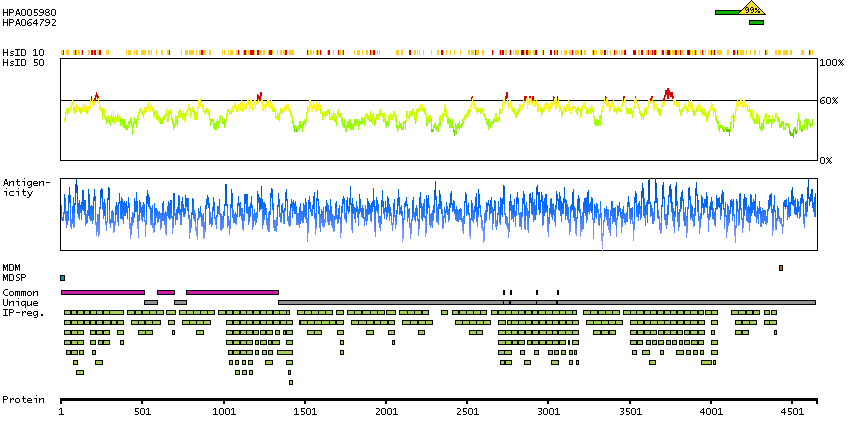
LRP2-001
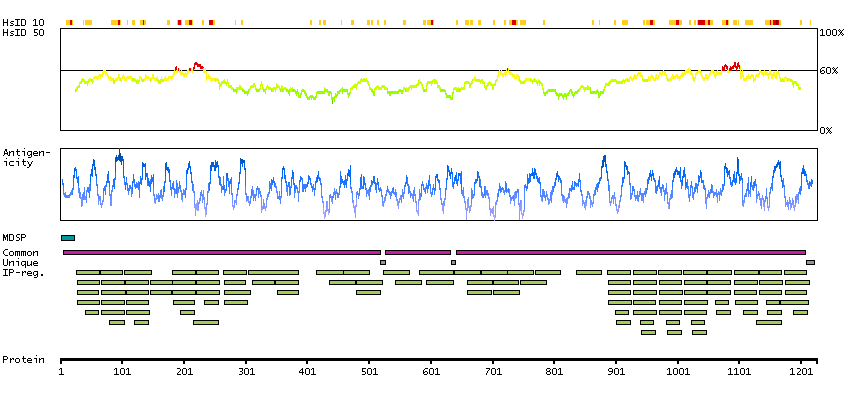
LRP2-005

PROTEIN INFORMATION

Splice variant

UniProt

Protein class

Gene ontology

Length & mass

Signal peptide
(predicted)

Transmembrane regions
(predicted)

LRP2-001
ENSP00000263816
ENST00000263816
P98164 [Direct mapping]
Low-density lipoprotein receptor-related protein 2
Show all
Predicted membrane proteins
   Prediction method-based
   Membrane proteins predicted by MDM
   MEMSAT-SVM predicted membrane proteins
   Phobius predicted membrane proteins
   SCAMPI predicted membrane proteins
   SPOCTOPUS predicted membrane proteins
   THUMBUP predicted membrane proteins
   TMHMM predicted membrane proteins
   # TM segments-based
   1TM proteins predicted by MDM
Plasma proteins
Disease related genes
Protein evidence (Kim et al 2014)
Protein evidence (Ezkurdia et al 2014)
Show all
GO:0001523 [retinoid metabolic process]
GO:0003281 [ventricular septum development]
GO:0005509 [calcium ion binding]
GO:0005515 [protein binding]
GO:0005764 [lysosome]
GO:0005765 [lysosomal membrane]
GO:0005768 [endosome]
GO:0005783 [endoplasmic reticulum]
GO:0005794 [Golgi apparatus]
GO:0005886 [plasma membrane]
GO:0005903 [brush border]
GO:0005905 [coated pit]
GO:0006486 [protein glycosylation]
GO:0006629 [lipid metabolic process]
GO:0006766 [vitamin metabolic process]
GO:0006897 [endocytosis]
GO:0006898 [receptor-mediated endocytosis]
GO:0007507 [heart development]
GO:0007603 [phototransduction, visible light]
GO:0008202 [steroid metabolic process]
GO:0008283 [cell proliferation]
GO:0016020 [membrane]
GO:0016021 [integral component of membrane]
GO:0016324 [apical plasma membrane]
GO:0017124 [SH3 domain binding]
GO:0017147 [Wnt-protein binding]
GO:0030139 [endocytic vesicle]
GO:0030900 [forebrain development]
GO:0031526 [brush border membrane]
GO:0035904 [aorta development]
GO:0042359 [vitamin D metabolic process]
GO:0042813 [Wnt-activated receptor activity]
GO:0043235 [receptor complex]
GO:0044281 [small molecule metabolic process]
GO:0044332 [Wnt signaling pathway involved in dorsal/ventral axis specification]
GO:0045177 [apical part of cell]
GO:0060070 [canonical Wnt signaling pathway]
GO:0060976 [coronary vasculature development]
GO:0070062 [extracellular exosome]
Show all
4655 aa
522 kDa
Yes 1
LRP2-005
ENSP00000409813
ENST00000443831
E9PC35 [Direct mapping]
Low-density lipoprotein receptor-related protein 2
Show all
Predicted secreted proteins
   Secreted proteins predicted by MDSEC
   SignalP predicted secreted proteins
   Phobius predicted secreted proteins
   SPOCTOPUS predicted secreted proteins
Protein evidence (Ezkurdia et al 2014)
Show all
GO:0005509 [calcium ion binding]
GO:0005515 [protein binding]
GO:0016021 [integral component of membrane]
GO:0017147 [Wnt-protein binding]
GO:0042813 [Wnt-activated receptor activity]
GO:0044332 [Wnt signaling pathway involved in dorsal/ventral axis specification]
GO:0060070 [canonical Wnt signaling pathway]
Show all
1225 aa
136.2 kDa
Yes 0

Contact

  • BLOG
  • PRESS ROOM
  • contact@proteinatlas.org

The Project

  • INTRODUCTION
  • ORGANIZATION
  • PUBLICATIONS
  • DOWNLOADABLE DATA

The Human Protein Atlas

  • ANTIBODY AVAILABILITY
  • LICENCE & CITATION
  • HELP & FAQ
The Human Protein Atlas project is funded
by the Knut & Alice Wallenberg foundation.