We use cookies to enhance the usability of our website. If you continue, we'll assume that you are happy to receive all cookies. More information. Don't show this again.
Fields »
 

Field

Term
Gene name

Class

Subclass

Chromosome

External id

In atlas

Reliability

Reliability

Reliability

Validation

Method

Validation

Method

Validation

Method

Validation

Location

Searches

Tissue

Cell type

Expression

Tissue

Specificity

Cell line

Specificity

Tissue

Detectable

Cell line

Detectable

Category

Score

Score

Score

Antibodies

Column


ABOUT
HELP
BLOG
  • THE HUMAN PROTEOME
  • THE HUMAN TISSUES
  • THE HUMAN CELL
  • PROTEIN CLASSES
  • PROTEIN EVIDENCE
    • NEWS
    • BLOG
    • EVENTS
    • PRESS ROOM
    • LEARN
    • DICTIONARY
    • METHODS
    • CELL LINES
  • THE PROJECT
  • INTRODUCTION
  • ORGANIZATION
  • PUBLICATIONS
  • PUBLICATION DATA
  • ANTIBODY SUBMISSION
  • ANTIBODY AVAILABILITY
  • LINKS
  • CONTACT
  • TECHNICAL DATA
  • ANTIBODY VALIDATION
  • ASSAYS & ANNOTATION
  • DISCLAIMER
  • DOWNLOADABLE DATA
  • HELP & FAQ
  • LICENCE & CITATION
  • PRIVACY STATEMENT
  • RELEASE HISTORY
OPN4
  • TISSUE

  • CELL

  • CANCER

TISSUE ATLAS PRIMARY DATA

GENE/PROTEIN

Antibody validation


Dictionary


Tissue proteome

GENERAL INFORMATION

Gene name

OPN4

Gene description

Opsin 4

Protein class

G-protein coupled receptors
Predicted membrane proteins
Transporters

Predicted localization

Membrane

Number of transcripts

3
SHOW MORE

HUMAN PROTEIN ATLAS INFORMATION

RNA tissue category

HPA:Tissue enhanced (cerebral cortex, parathyroid gland)
GTEx:Tissue enhanced (caudate)
FANTOM5:Tissue enhanced (caudate, skeletal muscle)

Protein evidence

Evidence at protein level

Protein expression

Strong cytoplasmic positivity in nerve fibers in retina.

DATA RELIABILITY

Data reliability
description

Limited external characterization data supports antibody staining but no internal RNA data available for correlation.

Reliability score

Approved based on 1 antibody.
HPA039147
SHOW MORE

RNA AND PROTEIN EXPRESSION SUMMARY

RNA expression (TPM) Protein expression (score)
Brain
Cerebral cortex
Hippocampus
N/A
Caudate
N/A
Cerebellum
N/A
Endocrine tissues
Thyroid gland
Parathyroid gland
Adrenal gland
Bone marrow & immune system
Appendix
Bone marrow
Lymph node
Tonsil
Spleen
Muscle tissues
Heart muscle
Skeletal muscle
Smooth muscle
Lung
Nasopharynx
N/A
N/A
Bronchus
N/A
Lung
Liver & gallbladder
Liver
Gallbladder
Pancreas
Pancreas
Gastrointestinal tract
Oral mucosa
N/A
Salivary gland
Esophagus
Stomach
Duodenum
Small intestine
Colon
Rectum
Kidney & urinary bladder
Kidney
Urinary bladder
Male tissues
Testis
Epididymis
Prostate
Seminal vesicle
Female tissues
Breast
Vagina
N/A
Cervix, uterine
Endometrium
Fallopian tube
Ovary
Placenta
Adipose & soft tissue
Adipose tissue
Soft tissue
N/A
Skin
Skin
Eye
N/A
Retina
N/A
Cerebral cortex

Lymph node

Liver

Colon

Kidney

Testis

Retina

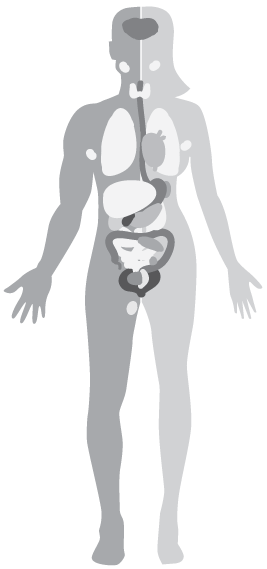
PROTEIN EXPRESSION OVERVIEW

Organ
Expression
Alphabetical

RNA EXPRESSION OVERVIEW

HPA dataset
Organ
Expression
Alphabetical
RNA tissue category: Tissue enhanced (cerebral cortex, parathyroid gland)
GTEx dataset
Organ
Expression
Alphabetical
RNA tissue category: Tissue enhanced (caudate)
FANTOM5 dataset
Organ
Expression
Alphabetical
RNA tissue category: Tissue enhanced (caudate, skeletal muscle)

GENE INFORMATION

Gene name

OPN4 (HGNC Symbol)

Synonyms

melanopsin, MOP

Description

Opsin 4 (HGNC Symbol)

Entrez gene summary

Opsins are members of the guanine nucleotide-binding protein (G protein)-coupled receptor superfamily. This gene encodes a photoreceptive opsin protein that is expressed within the ganglion and amacrine cell layers of the retina. In mouse, retinal ganglion cell axons expressing this gene projected to the suprachiasmatic nucleus and other brain nuclei involved in circadian photoentrainment. In mouse, this protein is coupled to a transient receptor potential (TRP) ion channel through a G protein signaling pathway and produces a physiologic light response via membrane depolarization and increased intracellular calcium. The protein functions as a sensory photopigment and may also have photoisomerase activity. Experiments with knockout mice indicate that this gene attenuates, but does not abolish, photoentrainment. Alternative splicing results in multiple transcript variants encoding different isoforms. [provided by RefSeq, Jul 2008]

Chromosome

10

Cytoband

q23.2

Chromosome location (bp)

86654557 - 86666848

Protein evidence

Evidence at protein level (all genes)

Ensembl

ENSG00000122375 (version 83.38)

Entrez gene

94233

UniProt

Q9UHM6 (UniProt - Evidence at protein level)

neXtProt

NX_Q9UHM6

Antibodypedia

OPN4 antibodies

PROTEIN BROWSER

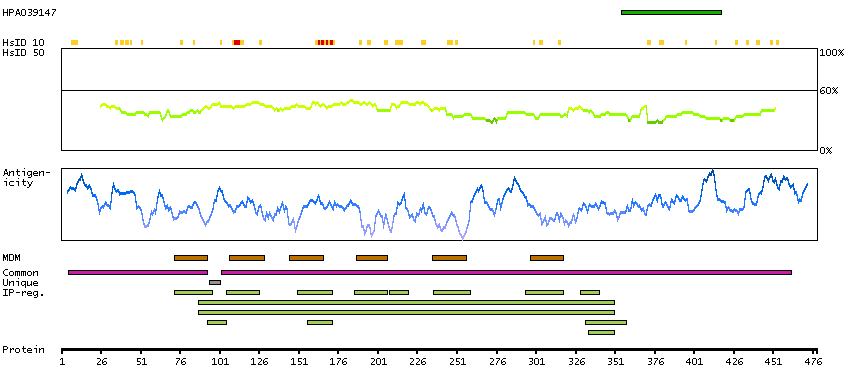
OPN4-001
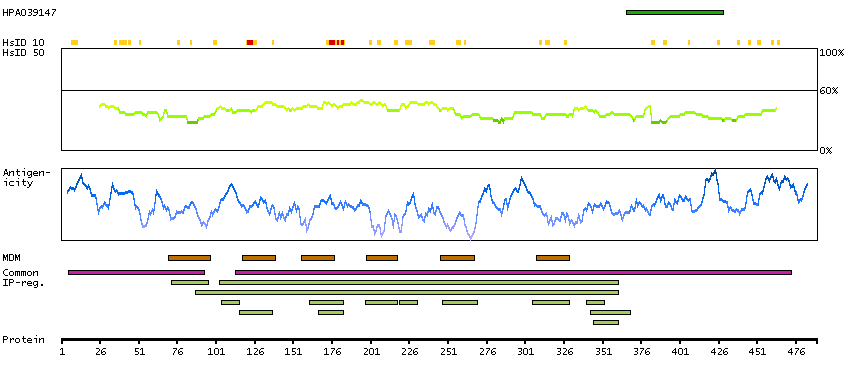
OPN4-002
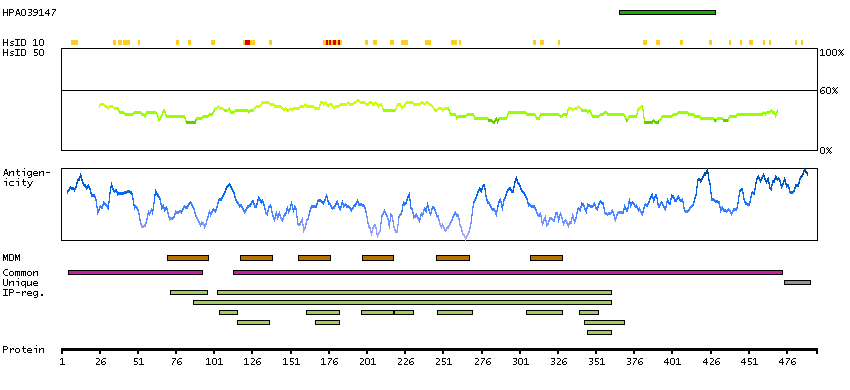
OPN4-201

PROTEIN INFORMATION

Splice variant

UniProt

Protein class

Gene ontology

Length & mass

Signal peptide
(predicted)

Transmembrane regions
(predicted)

OPN4-001
ENSP00000241891
ENST00000241891
Q9UHM6 [Direct mapping]
Melanopsin
Show all
Transporters
G-protein coupled receptors
   GPCRs excl olfactory receptors
   Opsins
Predicted membrane proteins
   Prediction method-based
   Membrane proteins predicted by MDM
   MEMSAT3 predicted membrane proteins
   MEMSAT-SVM predicted membrane proteins
   Phobius predicted membrane proteins
   SCAMPI predicted membrane proteins
   SPOCTOPUS predicted membrane proteins
   THUMBUP predicted membrane proteins
   TMHMM predicted membrane proteins
   GPCRHMM predicted membrane proteins
   # TM segments-based
   6TM proteins predicted by MDM
Show all
GO:0004930 [G-protein coupled receptor activity]
GO:0005502 [11-cis retinal binding]
GO:0005886 [plasma membrane]
GO:0007186 [G-protein coupled receptor signaling pathway]
GO:0007601 [visual perception]
GO:0007602 [phototransduction]
GO:0008020 [G-protein coupled photoreceptor activity]
GO:0016021 [integral component of membrane]
GO:0018298 [protein-chromophore linkage]
GO:0042752 [regulation of circadian rhythm]
GO:0048511 [rhythmic process]
Show all
478 aa
52.6 kDa
No 6
OPN4-002
ENSP00000393132
ENST00000443292
C9JWU6 [Direct mapping]
Melanopsin
Show all
Predicted membrane proteins
   Prediction method-based
   Membrane proteins predicted by MDM
   MEMSAT3 predicted membrane proteins
   MEMSAT-SVM predicted membrane proteins
   Phobius predicted membrane proteins
   SCAMPI predicted membrane proteins
   SPOCTOPUS predicted membrane proteins
   THUMBUP predicted membrane proteins
   TMHMM predicted membrane proteins
   GPCRHMM predicted membrane proteins
   # TM segments-based
   6TM proteins predicted by MDM
Show all
GO:0004930 [G-protein coupled receptor activity]
GO:0007186 [G-protein coupled receptor signaling pathway]
GO:0007601 [visual perception]
GO:0007602 [phototransduction]
GO:0009881 [photoreceptor activity]
GO:0016021 [integral component of membrane]
GO:0018298 [protein-chromophore linkage]
Show all
495 aa
54.5 kDa
No 6
OPN4-201
ENSP00000361141
ENST00000372071
Q9UHM6 [Direct mapping]
Melanopsin
Show all
Transporters
G-protein coupled receptors
   GPCRs excl olfactory receptors
   Opsins
Predicted membrane proteins
   Prediction method-based
   Membrane proteins predicted by MDM
   MEMSAT3 predicted membrane proteins
   MEMSAT-SVM predicted membrane proteins
   Phobius predicted membrane proteins
   SCAMPI predicted membrane proteins
   SPOCTOPUS predicted membrane proteins
   THUMBUP predicted membrane proteins
   TMHMM predicted membrane proteins
   GPCRHMM predicted membrane proteins
   # TM segments-based
   6TM proteins predicted by MDM
Show all
GO:0004930 [G-protein coupled receptor activity]
GO:0005502 [11-cis retinal binding]
GO:0005886 [plasma membrane]
GO:0007186 [G-protein coupled receptor signaling pathway]
GO:0007601 [visual perception]
GO:0007602 [phototransduction]
GO:0008020 [G-protein coupled photoreceptor activity]
GO:0016021 [integral component of membrane]
GO:0016056 [rhodopsin mediated signaling pathway]
GO:0018298 [protein-chromophore linkage]
GO:0042752 [regulation of circadian rhythm]
GO:0048511 [rhythmic process]
Show all
489 aa
53.8 kDa
No 6

Contact

  • BLOG
  • PRESS ROOM
  • contact@proteinatlas.org

The Project

  • INTRODUCTION
  • ORGANIZATION
  • PUBLICATIONS
  • DOWNLOADABLE DATA

The Human Protein Atlas

  • ANTIBODY AVAILABILITY
  • LICENCE & CITATION
  • HELP & FAQ
The Human Protein Atlas project is funded
by the Knut & Alice Wallenberg foundation.