We use cookies to enhance the usability of our website. If you continue, we'll assume that you are happy to receive all cookies. More information. Don't show this again.
Fields »
 

Field

Term
Gene name

Class

Subclass

Chromosome

External id

In atlas

Reliability

Reliability

Reliability

Validation

Method

Validation

Method

Validation

Method

Validation

Location

Searches

Tissue

Cell type

Expression

Tissue

Specificity

Cell line

Specificity

Tissue

Detectable

Cell line

Detectable

Category

Score

Score

Score

Antibodies

Column


ABOUT
HELP
BLOG
  • THE HUMAN PROTEOME
  • THE HUMAN TISSUES
  • THE HUMAN CELL
  • PROTEIN CLASSES
  • PROTEIN EVIDENCE
    • NEWS
    • BLOG
    • EVENTS
    • PRESS ROOM
    • LEARN
    • DICTIONARY
    • METHODS
    • CELL LINES
  • THE PROJECT
  • INTRODUCTION
  • ORGANIZATION
  • PUBLICATIONS
  • PUBLICATION DATA
  • ANTIBODY SUBMISSION
  • ANTIBODY AVAILABILITY
  • LINKS
  • CONTACT
  • TECHNICAL DATA
  • ANTIBODY VALIDATION
  • ASSAYS & ANNOTATION
  • DISCLAIMER
  • DOWNLOADABLE DATA
  • HELP & FAQ
  • LICENCE & CITATION
  • PRIVACY STATEMENT
  • RELEASE HISTORY
ALDOB
  • premium

    TISSUE

  • CELL

  • CANCER

TISSUE ATLAS PRIMARY DATA

GENE/PROTEIN

Antibody validation


Dictionary


Tissue proteome

GENERAL INFORMATION

Gene name

ALDOB

Gene description

Aldolase B, fructose-bisphosphate

Protein class

Cancer-related genes
Disease related genes
Enzymes
Plasma proteins
Potential drug targets
Predicted intracellular proteins

Predicted localization

Intracellular

Number of transcripts

2
SHOW MORE

HUMAN PROTEIN ATLAS INFORMATION

RNA tissue category

HPA:Group enriched (kidney, small intestine, liver, duodenum)
GTEx:Group enriched (liver, kidney, small intestine)
FANTOM5:Tissue enhanced (small intestine, liver, colon)

Protein evidence

Evidence at protein level

Protein expression

Selective cytoplasmic expression in renal tubules, hepatocytes and parts of the intestine.

DATA RELIABILITY

Data reliability
description

Antibody staining mainly consistent with RNA expression data.

Reliability score

Supported based on 2 antibodies.
HPA002198 , CAB020827
SHOW MORE

RNA AND PROTEIN EXPRESSION SUMMARY

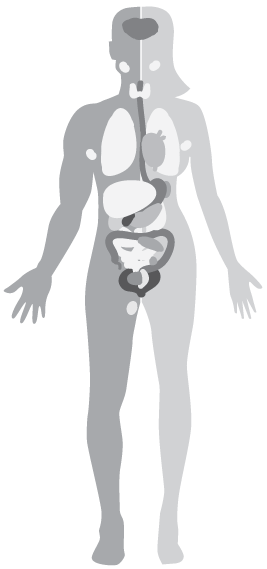
RNA expression (TPM) Protein expression (score)
Brain
Cerebral cortex
Hippocampus
N/A
Caudate
N/A
Cerebellum
N/A
Endocrine tissues
Thyroid gland
Parathyroid gland
Adrenal gland
Bone marrow & immune system
Appendix
Bone marrow
Lymph node
Tonsil
Spleen
Muscle tissues
Heart muscle
Skeletal muscle
Smooth muscle
Lung
Nasopharynx
N/A
Bronchus
N/A
Lung
Liver & gallbladder
Liver
Gallbladder
Pancreas
Pancreas
Gastrointestinal tract
Oral mucosa
N/A
Salivary gland
Esophagus
Stomach
Duodenum
Small intestine
Colon
Rectum
Kidney & urinary bladder
Kidney
Urinary bladder
Male tissues
Testis
Epididymis
Prostate
Seminal vesicle
Female tissues
Breast
Vagina
N/A
Cervix, uterine
Endometrium
Fallopian tube
Ovary
Placenta
Adipose & soft tissue
Adipose tissue
Soft tissue
N/A
Skin
Skin
Cerebral cortex

Lymph node

Liver

Small intestine

Colon

Kidney

Testis

PROTEIN EXPRESSION OVERVIEW

Organ
Expression
Alphabetical

RNA EXPRESSION OVERVIEW

HPA dataset
Organ
Expression
Alphabetical
RNA tissue category: Group enriched (kidney, small intestine, liver, duodenum)
GTEx dataset
Organ
Expression
Alphabetical
RNA tissue category: Group enriched (liver, kidney, small intestine)
FANTOM5 dataset
Organ
Expression
Alphabetical
RNA tissue category: Tissue enhanced (small intestine, liver, colon)

GENE INFORMATION

Gene name

ALDOB

Synonyms

Description

Aldolase B, fructose-bisphosphate (HGNC Symbol)

Entrez gene summary

Fructose-1,6-bisphosphate aldolase (EC 4.1.2.13) is a tetrameric glycolytic enzyme that catalyzes the reversible conversion of fructose-1,6-bisphosphate to glyceraldehyde 3-phosphate and dihydroxyacetone phosphate. Vertebrates have 3 aldolase isozymes which are distinguished by their electrophoretic and catalytic properties. Differences indicate that aldolases A, B, and C are distinct proteins, the products of a family of related 'housekeeping' genes exhibiting developmentally regulated expression of the different isozymes. The developing embryo produces aldolase A, which is produced in even greater amounts in adult muscle where it can be as much as 5% of total cellular protein. In adult liver, kidney and intestine, aldolase A expression is repressed and aldolase B is produced. In brain and other nervous tissue, aldolase A and C are expressed about equally. There is a high degree of homology between aldolase A and C. Defects in ALDOB cause hereditary fructose intolerance. [provided by RefSeq, Dec 2008]

Chromosome

9

Cytoband

q31.1

Chromosome location (bp)

101420578 - 101435823

Protein evidence

Evidence at protein level (all genes)

Ensembl

ENSG00000136872 (version 83.38)

Entrez gene

229

UniProt

P05062 (UniProt - Evidence at protein level)

neXtProt

NX_P05062

Antibodypedia

ALDOB antibodies

PROTEIN BROWSER

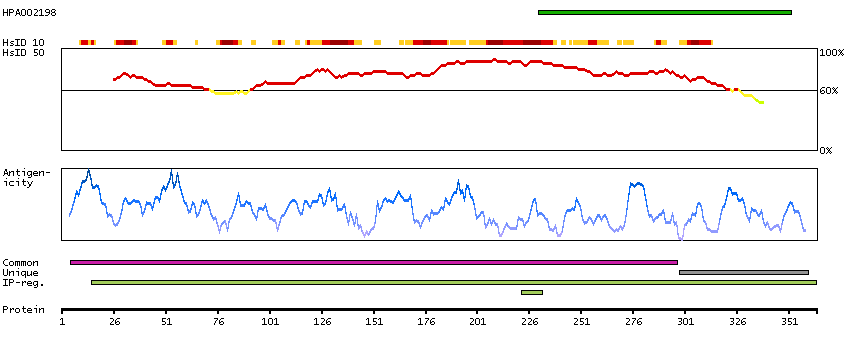
ALDOB-001
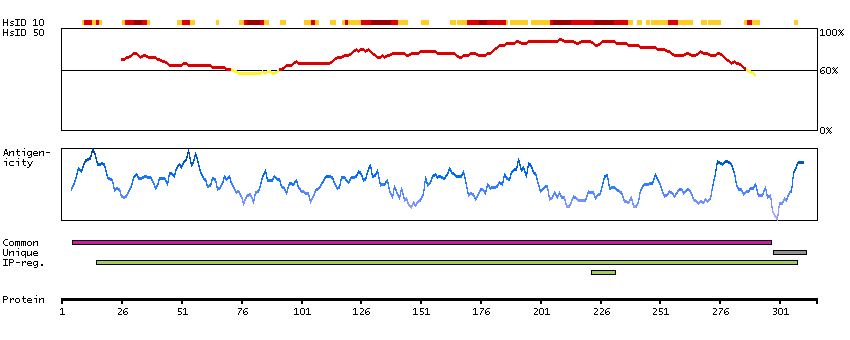
ALDOB-201

PROTEIN INFORMATION

Splice variant

UniProt

Protein class

Gene ontology

Length & mass

Signal peptide
(predicted)

Transmembrane regions
(predicted)

ALDOB-001
ENSP00000363988
ENST00000374855
P05062 [Direct mapping]
Fructose-bisphosphate aldolase B
A0A024R145 [Target identity:100%; Query identity:100%]
Fructose-bisphosphate aldolase
Show all
Enzymes
   ENZYME proteins
   Lyases
Predicted intracellular proteins
Plasma proteins
Cancer-related genes
   Candidate cancer biomarkers
Disease related genes
Potential drug targets
Protein evidence (Kim et al 2014)
Protein evidence (Ezkurdia et al 2014)
Show all
GO:0001889 [liver development]
GO:0004332 [fructose-bisphosphate aldolase activity]
GO:0005515 [protein binding]
GO:0005634 [nucleus]
GO:0005737 [cytoplasm]
GO:0005764 [lysosome]
GO:0005815 [microtubule organizing center]
GO:0005829 [cytosol]
GO:0005886 [plasma membrane]
GO:0005975 [carbohydrate metabolic process]
GO:0006000 [fructose metabolic process]
GO:0006006 [glucose metabolic process]
GO:0006094 [gluconeogenesis]
GO:0006096 [glycolytic process]
GO:0006116 [NADH oxidation]
GO:0008092 [cytoskeletal protein binding]
GO:0009743 [response to carbohydrate]
GO:0009750 [response to fructose]
GO:0010043 [response to zinc ion]
GO:0014070 [response to organic cyclic compound]
GO:0030388 [fructose 1,6-bisphosphate metabolic process]
GO:0030867 [rough endoplasmic reticulum membrane]
GO:0030868 [smooth endoplasmic reticulum membrane]
GO:0031210 [phosphatidylcholine binding]
GO:0031668 [cellular response to extracellular stimulus]
GO:0032781 [positive regulation of ATPase activity]
GO:0032869 [cellular response to insulin stimulus]
GO:0034451 [centriolar satellite]
GO:0042493 [response to drug]
GO:0042594 [response to starvation]
GO:0042802 [identical protein binding]
GO:0043200 [response to amino acid]
GO:0043231 [intracellular membrane-bounded organelle]
GO:0043434 [response to peptide hormone]
GO:0044281 [small molecule metabolic process]
GO:0046688 [response to copper ion]
GO:0048471 [perinuclear region of cytoplasm]
GO:0051117 [ATPase binding]
GO:0051384 [response to glucocorticoid]
GO:0051591 [response to cAMP]
GO:0061609 [fructose-1-phosphate aldolase activity]
GO:0061621 [canonical glycolysis]
GO:0061624 [fructose catabolic process to hydroxyacetone phosphate and glyceraldehyde-3-phosphate]
GO:0070061 [fructose binding]
GO:0070062 [extracellular exosome]
GO:0070072 [vacuolar proton-transporting V-type ATPase complex assembly]
GO:0070741 [response to interleukin-6]

Show all
364 aa
39.5 kDa
No 0
ALDOB-201
ENSP00000481363
ENST00000616752
A0A087WXX2 [Direct mapping]
Fructose-bisphosphate aldolase
Show all
Predicted intracellular proteins
Protein evidence (Ezkurdia et al 2014)
Show all
GO:0004332 [fructose-bisphosphate aldolase activity]
GO:0006096 [glycolytic process]
Show all
316 aa
34.9 kDa
No 0

Contact

  • BLOG
  • PRESS ROOM
  • contact@proteinatlas.org

The Project

  • INTRODUCTION
  • ORGANIZATION
  • PUBLICATIONS
  • DOWNLOADABLE DATA

The Human Protein Atlas

  • ANTIBODY AVAILABILITY
  • LICENCE & CITATION
  • HELP & FAQ
The Human Protein Atlas project is funded
by the Knut & Alice Wallenberg foundation.