We use cookies to enhance the usability of our website. If you continue, we'll assume that you are happy to receive all cookies. More information. Don't show this again.
Fields »
 

Field

Term
Gene name

Class

Subclass

Chromosome

External id

In atlas

Reliability

Reliability

Reliability

Validation

Method

Validation

Method

Validation

Method

Validation

Location

Searches

Tissue

Cell type

Expression

Tissue

Specificity

Cell line

Specificity

Tissue

Detectable

Cell line

Detectable

Category

Score

Score

Score

Antibodies

Column


ABOUT
HELP
BLOG
  • THE HUMAN PROTEOME
  • THE HUMAN TISSUES
  • THE HUMAN CELL
  • PROTEIN CLASSES
  • PROTEIN EVIDENCE
    • NEWS
    • BLOG
    • EVENTS
    • PRESS ROOM
    • LEARN
    • DICTIONARY
    • METHODS
    • CELL LINES
  • THE PROJECT
  • INTRODUCTION
  • ORGANIZATION
  • PUBLICATIONS
  • PUBLICATION DATA
  • ANTIBODY SUBMISSION
  • ANTIBODY AVAILABILITY
  • LINKS
  • CONTACT
  • TECHNICAL DATA
  • ANTIBODY VALIDATION
  • ASSAYS & ANNOTATION
  • DISCLAIMER
  • DOWNLOADABLE DATA
  • HELP & FAQ
  • LICENCE & CITATION
  • PRIVACY STATEMENT
  • RELEASE HISTORY
RBP3
  • TISSUE

  • CELL

  • CANCER

TISSUE ATLAS PRIMARY DATA

GENE/PROTEIN

Antibody validation


Dictionary


Tissue proteome

GENERAL INFORMATION

Gene name

RBP3

Gene description

Retinol binding protein 3, interstitial

Protein class

Disease related genes
Enzymes
Potential drug targets
Predicted secreted proteins

Predicted localization

Secreted

Number of transcripts

1
SHOW MORE

HUMAN PROTEIN ATLAS INFORMATION

RNA tissue category

HPA:Not detected
FANTOM5:Tissue enriched (retina)

Protein evidence

Evidence at protein level

Protein expression

Cytoplasmic expression in photoreceptor cells.

DATA RELIABILITY

Data reliability
description

External characterization data supports antibody staining but no internal RNA data available for correlation.

Reliability score

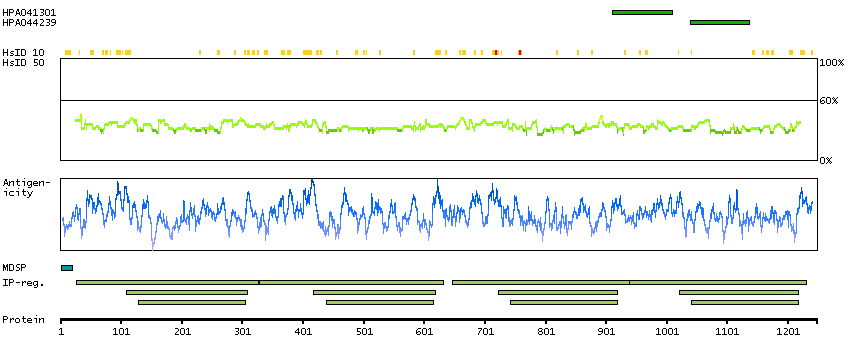
Supported based on 2 antibodies.
HPA041301 , HPA044239
SHOW MORE

RNA AND PROTEIN EXPRESSION SUMMARY

RNA expression (TPM) Protein expression (score)
Brain
Cerebral cortex
Hippocampus
N/A
Caudate
N/A
Cerebellum
N/A
Endocrine tissues
Thyroid gland
Parathyroid gland
Adrenal gland
Bone marrow & immune system
Appendix
Bone marrow
Lymph node
Tonsil
Spleen
Muscle tissues
Heart muscle
Skeletal muscle
Smooth muscle
Lung
Nasopharynx
N/A
Bronchus
N/A
Lung
Liver & gallbladder
Liver
Gallbladder
Pancreas
Pancreas
Gastrointestinal tract
Oral mucosa
N/A
Salivary gland
Esophagus
Stomach
Duodenum
Small intestine
Colon
Rectum
Kidney & urinary bladder
Kidney
Urinary bladder
Male tissues
Testis
Epididymis
Prostate
Seminal vesicle
Female tissues
Breast
Vagina
N/A
Cervix, uterine
Endometrium
Fallopian tube
Ovary
Placenta
Adipose & soft tissue
Adipose tissue
Soft tissue
N/A
Skin
Skin
Eye
N/A
Retina
N/A
Cerebral cortex

Lymph node

Liver

Colon

Kidney

Testis

Retina

PROTEIN EXPRESSION OVERVIEW

Organ
Expression
Alphabetical

RNA EXPRESSION OVERVIEW

HPA dataset
Organ
Expression
Alphabetical
RNA tissue category: Not detected
FANTOM5 dataset
Organ
Expression
Alphabetical
RNA tissue category: Tissue enriched (retina)

GENE INFORMATION

Gene name

RBP3 (HGNC Symbol)

Synonyms

D10S64, D10S65, D10S66, RP66

Description

Retinol binding protein 3, interstitial (HGNC Symbol)

Entrez gene summary

Interphotoreceptor retinol-binding protein is a large glycoprotein known to bind retinoids and found primarily in the interphotoreceptor matrix of the retina between the retinal pigment epithelium and the photoreceptor cells. It is thought to transport retinoids between the retinal pigment epithelium and the photoreceptors, a critical role in the visual process.The human IRBP gene is approximately 9.5 kbp in length and consists of four exons separated by three introns. The introns are 1.6-1.9 kbp long. The gene is transcribed by photoreceptor and retinoblastoma cells into an approximately 4.3-kilobase mRNA that is translated and processed into a glycosylated protein of 135,000 Da. The amino acid sequence of human IRBP can be divided into four contiguous homology domains with 33-38% identity, suggesting a series of gene duplication events. In the gene, the boundaries of these domains are not defined by exon-intron junctions, as might have been expected. The first three homology domains and part of the fourth are all encoded by the first large exon, which is 3,180 base pairs long. The remainder of the fourth domain is encoded in the last three exons, which are 191, 143, and approximately 740 base pairs long, respectively. [provided by RefSeq, Jul 2008]

Chromosome

10

Cytoband

q11.22

Chromosome location (bp)

47348371 - 47357875

Protein evidence

Evidence at protein level (all genes)

Ensembl

ENSG00000265203 (version 83.38)

Entrez gene

5949

UniProt

P10745 (UniProt - Evidence at protein level)

neXtProt

NX_P10745

Antibodypedia

RBP3 antibodies

PROTEIN BROWSER

RBP3-001

PROTEIN INFORMATION

Splice variant

UniProt

Protein class

Gene ontology

Length & mass

Signal peptide
(predicted)

Transmembrane regions
(predicted)

RBP3-001
ENSP00000463151
ENST00000584701
P10745 [Direct mapping]
Retinol-binding protein 3
Show all
Enzymes
   Peptidases
   Serine-type peptidases
   THUMBUP predicted membrane proteins
Predicted secreted proteins
   Secreted proteins predicted by MDSEC
   SignalP predicted secreted proteins
   Phobius predicted secreted proteins
   SPOCTOPUS predicted secreted proteins
Disease related genes
Potential drug targets
Protein evidence (Kim et al 2014)
Show all
GO:0001523 [retinoid metabolic process]
GO:0005501 [retinoid binding]
GO:0005576 [extracellular region]
GO:0005615 [extracellular space]
GO:0006508 [proteolysis]
GO:0006629 [lipid metabolic process]
GO:0006810 [transport]
GO:0007601 [visual perception]
GO:0007603 [phototransduction, visible light]
GO:0008236 [serine-type peptidase activity]
GO:0016918 [retinal binding]
GO:0019841 [retinol binding]
GO:0033165 [interphotoreceptor matrix]
GO:1903561 [extracellular vesicle]
Show all
1247 aa
135.4 kDa
Yes 0

Contact

  • BLOG
  • PRESS ROOM
  • contact@proteinatlas.org

The Project

  • INTRODUCTION
  • ORGANIZATION
  • PUBLICATIONS
  • DOWNLOADABLE DATA

The Human Protein Atlas

  • ANTIBODY AVAILABILITY
  • LICENCE & CITATION
  • HELP & FAQ
The Human Protein Atlas project is funded
by the Knut & Alice Wallenberg foundation.