We use cookies to enhance the usability of our website. If you continue, we'll assume that you are happy to receive all cookies. More information. Don't show this again.
Fields »
 

Field

Term
Gene name

Class

Subclass

Chromosome

External id

In atlas

Reliability

Reliability

Reliability

Validation

Method

Validation

Method

Validation

Method

Validation

Location

Searches

Tissue

Cell type

Expression

Tissue

Specificity

Cell line

Specificity

Tissue

Detectable

Cell line

Detectable

Category

Score

Score

Score

Antibodies

Column


ABOUT
HELP
BLOG
  • THE HUMAN PROTEOME
  • THE HUMAN TISSUES
  • THE HUMAN CELL
  • PROTEIN CLASSES
  • PROTEIN EVIDENCE
    • NEWS
    • BLOG
    • EVENTS
    • PRESS ROOM
    • LEARN
    • DICTIONARY
    • METHODS
    • CELL LINES
  • THE PROJECT
  • INTRODUCTION
  • ORGANIZATION
  • PUBLICATIONS
  • PUBLICATION DATA
  • ANTIBODY SUBMISSION
  • ANTIBODY AVAILABILITY
  • LINKS
  • CONTACT
  • TECHNICAL DATA
  • ANTIBODY VALIDATION
  • ASSAYS & ANNOTATION
  • DISCLAIMER
  • DOWNLOADABLE DATA
  • HELP & FAQ
  • LICENCE & CITATION
  • PRIVACY STATEMENT
  • RELEASE HISTORY
ITPKA
  • TISSUE

  • CELL

  • CANCER

TISSUE ATLAS PRIMARY DATA
MOUSE BRAIN

GENE/PROTEIN

Antibody validation


Dictionary


Tissue proteome

GENERAL INFORMATION

Gene name

ITPKA

Gene description

Inositol-trisphosphate 3-kinase A

Protein class

Enzymes
Predicted intracellular proteins

Predicted localization

Intracellular

Number of transcripts

2
SHOW MORE

HUMAN PROTEIN ATLAS INFORMATION

RNA tissue category

HPA:Tissue enhanced (cerebral cortex, small intestine, duodenum)
GTEx:Tissue enhanced (cerebral cortex, caudate)
FANTOM5:Tissue enhanced (caudate, brain, small intestine)

Protein evidence

Evidence at protein level

Protein expression

Distinct expression in astrocytes and processes in CNS.

DATA RELIABILITY

Data reliability
description

Antibody staining mainly consistent with RNA expression data. Pending external verification.

Reliability score

Approved based on 1 antibody.
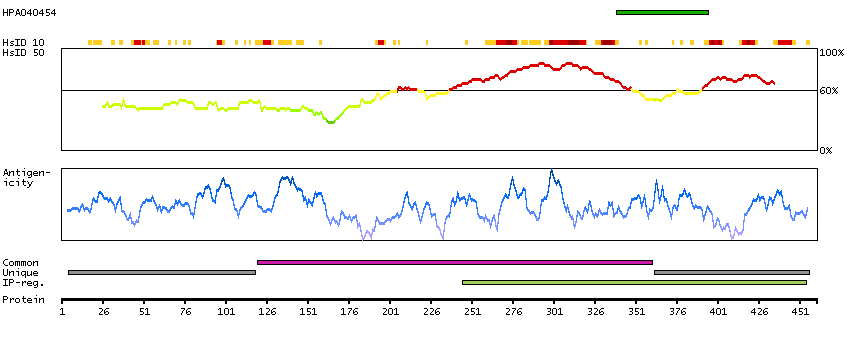
HPA040454
SHOW MORE

RNA AND PROTEIN EXPRESSION SUMMARY

RNA expression (TPM) Protein expression (score)
Brain
Cerebral cortex
Hippocampus
N/A
Caudate
N/A
Cerebellum
N/A
Endocrine tissues
Thyroid gland
Parathyroid gland
Adrenal gland
Bone marrow & immune system
Appendix
Bone marrow
Lymph node
Tonsil
Spleen
Muscle tissues
Heart muscle
Skeletal muscle
Smooth muscle
Lung
Nasopharynx
N/A
Bronchus
N/A
Lung
Liver & gallbladder
Liver
Gallbladder
Pancreas
Pancreas
Gastrointestinal tract
Oral mucosa
N/A
Salivary gland
Esophagus
Stomach
Duodenum
Small intestine
Colon
Rectum
Kidney & urinary bladder
Kidney
Urinary bladder
Male tissues
Testis
Epididymis
Prostate
Seminal vesicle
Female tissues
Breast
Vagina
N/A
Cervix, uterine
Endometrium
Fallopian tube
Ovary
Placenta
Adipose & soft tissue
Adipose tissue
Soft tissue
N/A
Skin
Skin
Cerebral cortex

Caudate

Lymph node

Liver

Colon

Kidney

Testis

PROTEIN EXPRESSION OVERVIEW

Organ
Expression
Alphabetical

RNA EXPRESSION OVERVIEW

HPA dataset
Organ
Expression
Alphabetical
RNA tissue category: Tissue enhanced (cerebral cortex, small intestine, duodenum)
GTEx dataset
Organ
Expression
Alphabetical
RNA tissue category: Tissue enhanced (cerebral cortex, caudate)
FANTOM5 dataset
Organ
Expression
Alphabetical
RNA tissue category: Tissue enhanced (caudate, brain, small intestine)

GENE INFORMATION

Gene name

ITPKA (HGNC Symbol)

Synonyms

IP3-3KA, IP3KA

Description

Inositol-trisphosphate 3-kinase A (HGNC Symbol)

Entrez gene summary

Regulates inositol phosphate metabolism by phosphorylation of second messenger inositol 1,4,5-trisphosphate to Ins(1,3,4,5)P4. The activity of the inositol 1,4,5-trisphosphate 3-kinase is responsible for regulating the levels of a large number of inositol polyphosphates that are important in cellular signaling. Both calcium/calmodulin and protein phosphorylation mechanisms control its activity. It is also a substrate for the cyclic AMP-dependent protein kinase, calcium/calmodulin- dependent protein kinase II, and protein kinase C in vitro.[provided by RefSeq, Apr 2011]

Chromosome

15

Cytoband

q15.1

Chromosome location (bp)

41493393 - 41503551

Protein evidence

Evidence at protein level (all genes)

Ensembl

ENSG00000137825 (version 83.38)

Entrez gene

3706

UniProt

P23677 (UniProt - Evidence at protein level)

neXtProt

NX_P23677

Antibodypedia

ITPKA antibodies

PROTEIN BROWSER

ITPKA-001
ITPKA-002

PROTEIN INFORMATION

Splice variant

UniProt

Protein class

Gene ontology

Length & mass

Signal peptide
(predicted)

Transmembrane regions
(predicted)

ITPKA-001
ENSP00000260386
ENST00000260386
P23677 [Direct mapping]
Inositol-trisphosphate 3-kinase A
Show all
Enzymes
   ENZYME proteins
   Transferases
   SPOCTOPUS predicted secreted proteins
Predicted intracellular proteins
Protein evidence (Kim et al 2014)
Protein evidence (Ezkurdia et al 2014)

Show all
GO:0004683 [calmodulin-dependent protein kinase activity]
GO:0005516 [calmodulin binding]
GO:0005524 [ATP binding]
GO:0005829 [cytosol]
GO:0006020 [inositol metabolic process]
GO:0006468 [protein phosphorylation]
GO:0007165 [signal transduction]
GO:0008440 [inositol-1,4,5-trisphosphate 3-kinase activity]
GO:0030036 [actin cytoskeleton organization]
GO:0043197 [dendritic spine]
GO:0043647 [inositol phosphate metabolic process]
GO:0044281 [small molecule metabolic process]
GO:0048167 [regulation of synaptic plasticity]
GO:0048365 [Rac GTPase binding]
GO:0061003 [positive regulation of dendritic spine morphogenesis]
GO:0097062 [dendritic spine maintenance]
Show all
461 aa
51 kDa
No 0
ITPKA-002
ENSP00000396560
ENST00000425927
C9JC74 [Direct mapping]
Inositol-trisphosphate 3-kinase A
Show all
Predicted intracellular proteins
Protein evidence (Ezkurdia et al 2014)
Show all
GO:0008440 [inositol-1,4,5-trisphosphate 3-kinase activity]
GO:0016310 [phosphorylation]
Show all
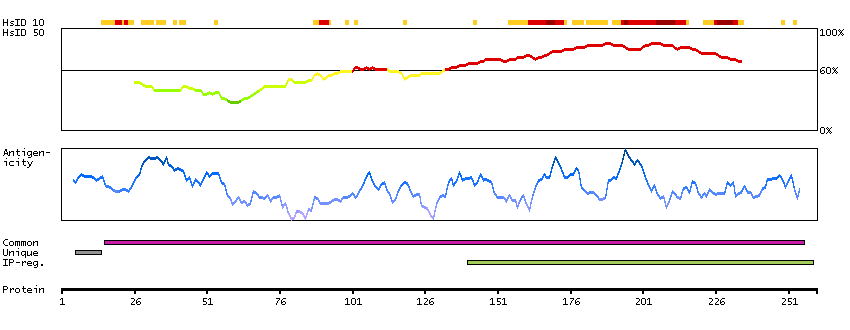
260 aa
29.3 kDa
No 0

Contact

  • BLOG
  • PRESS ROOM
  • contact@proteinatlas.org

The Project

  • INTRODUCTION
  • ORGANIZATION
  • PUBLICATIONS
  • DOWNLOADABLE DATA

The Human Protein Atlas

  • ANTIBODY AVAILABILITY
  • LICENCE & CITATION
  • HELP & FAQ
The Human Protein Atlas project is funded
by the Knut & Alice Wallenberg foundation.